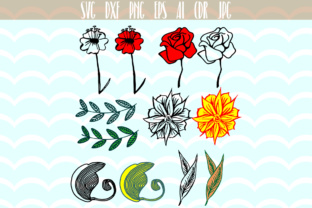
Floral Elements Files: Elevating Creative Projects with Hand-Painted Botanical Assets
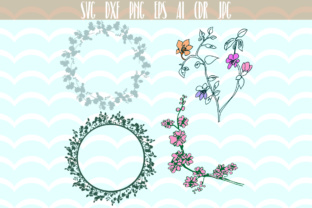
In the world of digital design and crafting, finding high-quality, versatile botanical graphics can often feel like searching for a needle in a haystack. Designers, crafters, and small business owners frequently encounter the same frustrating bottleneck: they have a vision for a project involving natural aesthetics, but the available assets are either too generic, low-resolution, or incompatible with their specific software. This is where Floral Elements Files serve as a critical resource. This comprehensive collection features a stunning set of hand-painted flowers and leaves that bridge the gap between traditional artistic warmth and modern digital precision.
Unlike standard vector clip art that can sometimes appear sterile or overly geometric, these files retain the organic texture and fluidity of hand-painting. Whether you are operating a CNC machine, designing wedding stationery, or creating custom apparel, having access to this specific suite of floral elements ensures your work maintains a professional, artisanal quality. The true value lies not just in the aesthetic beauty, but in the technical versatility provided by the inclusion of eight distinct file formats, ensuring that no matter what tool you use, the solution is ready for immediate implementation.
Overcoming Common Design and Fabrication Challenges
Creative professionals face several distinct challenges when integrating botanical themes into their work. Understanding these pain points helps clarify why a multi-format download like Floral Elements Files is so essential for workflow efficiency.
The Resolution and Scalability Dilemma
One of the most frequent issues in surface pattern design and large-format printing is pixelation. A designer might find a beautiful flower image online, only to discover it becomes blurry when scaled up for a banner or fabric print. Raster images (like standard photos) have fixed resolutions. By utilizing the vector-based formats included in this set—specifically AI, EPS, SVG, and CDR—users can scale these hand-painted florals to the size of a billboard without losing a single brushstroke detail. Conversely, for web designers or social media managers who need optimized raster graphics, the included high-resolution JPG and PNG files provide ready-to-use assets that maintain crispness on digital screens without requiring manual conversion.
Software Compatibility Barriers
The creative industry is fragmented across various software ecosystems. An illustrator uses Adobe Illustrator, a sign maker uses CorelDRAW, and a laser engraving enthusiast uses LightBurn or specialized CAM software. A common frustration is purchasing a digital asset only to realize it is in a proprietary format that your software cannot open. Floral Elements Files addresses this interoperability crisis directly. By providing DXF and DWG files alongside standard graphic design formats, this package ensures that engineers, architects, and fabrication specialists can import these organic shapes directly into CAD environments for precise cutting and machining, eliminating the need for complex and often inaccurate file tracing.
Achieving Authentic Texture in Digital Spaces
Digital designs often suffer from looking "too perfect." In an era where consumers crave authenticity, flat vector flowers can fail to evoke emotion. Because these elements are derived from hand-painted originals, they carry inherent imperfections, color gradients, and brush textures that purely digital drawings lack. For users aiming to create products that feel bespoke and human-made, these files offer the best of both worlds: the editability of digital vectors combined with the soul of traditional media.
Practical Applications Across Industries
The utility of Floral Elements Files extends far beyond simple decoration. Different user groups leverage these assets to solve specific production needs and enhance product offerings.
CNC Routing, Laser Cutting, and Vinyl Plotting
For makers using machines like Cricut, Silhouette, Glowforge, or industrial CNC routers, clean line work is non-negotiable. The DXF and SVG files in this set are optimized for fabrication. Makers can use these floral outlines to create intricate wooden wall art, acrylic cake toppers, leather earrings, or vinyl decals. Because the paths are derived from hand-painted sources, the resulting cutouts have unique, organic edges rather than rigid mechanical curves. This distinction allows fabricated products to stand out in saturated marketplaces like Etsy, where customers actively seek items that do not look mass-produced.
Stationery, Packaging, and Brand Identity
Graphic designers working on wedding invitations, cosmetic packaging, or boutique branding require assets that convey elegance and nature. The AI and EPS files allow designers to recolor individual petals and leaves to match specific brand palettes perfectly. Unlike flattened JPEGs, these layered vectors enable the separation of elements, allowing a designer to place a leaf behind text while keeping the flower in the foreground. This depth creates sophisticated compositions for luxury packaging or event collateral. The transparent PNG files also serve as excellent quick-add elements for mockups and social media announcements where full editing is not required.
Textile and Surface Pattern Design
Fashion designers and textile artists utilize these floral elements to build repeating patterns. The seamless scalability of the vector files means a motif can be resized to fit different garment panels or home decor items without re-drawing. The hand-painted aesthetic translates exceptionally well to sublimation printing and direct-to-garment (DTG) applications, where ink absorption mimics the original watercolor or gouache texture. Users can arrange these elements to create dense, lush prints for summer dresses or sparse, minimalist layouts for linen tableware.
Navigating File Formats for Optimal Results
To maximize the usefulness of Floral Elements Files, it is important to understand which format suits your specific objective. While having all options is beneficial, knowing which one to prioritize saves time and prevents technical errors.
- AI (Adobe Illustrator): The native source file for professional graphic designers. Use this for extensive editing, recoloring, and combining with other vector typography. It preserves all layers and effects.
- EPS (Encapsulated PostScript): The universal vector standard. Ideal if you use older versions of Illustrator or alternative vector software like Affinity Designer. It is highly compatible for print shops and commercial signage.
- SVG (Scalable Vector Graphics): The primary choice for crafters and web developers. Supported natively by Cricut Design Space, Silhouette Studio, and web browsers. It keeps file sizes small while maintaining infinite scalability.
- DXF (Drawing Exchange Format) & DWG: Essential for CAD users and CNC operators. These formats define geometry mathematically, making them perfect for toolpath generation in machining. Note that some artistic textures may be simplified to outlines in these formats to ensure cutting accuracy.
- CDR (CorelDRAW): Specifically for users within the Corel ecosystem. Having a native CDR file prevents import errors that can occur when converting EPS files within CorelDRAW.
- PNG & JPG: Best for digital previews, mood boards, web content, and users who do not own vector software. The PNG includes transparency for easy layering over backgrounds, while the JPG provides a solid background for reference or simple printing.
Implementation Tips and Creative Considerations
When integrating Floral Elements Files into your workflow, consider the end medium. If you are preparing files for laser cutting, always test a small section first. Hand-painted lines can sometimes be interpreted as double lines by CAM software; using the "outline" or "trace bitmap" function sparingly may be necessary to achieve a single continuous cut path. For print projects, verify the color mode. Vectors are typically CMYK-friendly, but if you are using the PNG/JPG versions for professional printing, ensure they meet the DPI requirements of your printer.
Furthermore, while these files are ready to use, they are designed to be a foundation. The most successful outcomes often come from modifying the base assets. Rotate leaves to create custom wreaths, adjust opacity to create watermarks, or mix multiple floral varieties to build a unique garden scene. By treating Floral Elements Files as a flexible toolkit rather than a static image library, creators can produce original work that resonates with audiences seeking genuine craftsmanship in a digital age.
Ultimately, this collection solves the logistical friction of creative production. It removes the barriers of format incompatibility and resolution anxiety, allowing adults and professionals to focus entirely on the application of beauty to their functional and artistic endeavors. Whether for commercial gain or personal expression, these hand-painted botanical assets provide a reliable, high-quality starting point for a vast array of creative possibilities.