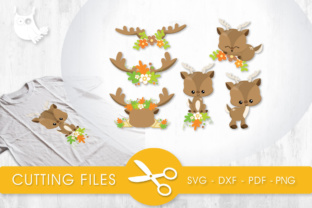
Evaluating Fall Floral Deer Designs: Format Compatibility and Creative Applications
The intersection of autumnal aesthetics and wildlife motifs has established the Fall Floral Deer as a staple in seasonal crafting. Unlike generic holiday clip art, this specific design category blends the organic elegance of botanical elements with the rustic charm of forest fauna. For crafters aged 20 to 50 who are managing personal projects or small business inventories, selecting the right digital asset requires more than an appreciation of the artwork; it demands a technical understanding of file formats and application suitability. When evaluating a cutting file set that includes SVG, DXF, PDF, and PNG options, the decision-making process should focus on workflow efficiency, machine compatibility, and the intended end-use of the final product.
Distinguishing Characteristics of the Fall Floral Deer Motif
Before assessing technical specifications, it is valuable to understand why this specific motif performs differently than standard deer silhouettes or isolated floral patterns. The Fall Floral Deer is distinct because of its compositional integration. In high-quality versions of this design, the florals are not merely layered on top of the animal; they often form the negative space, the antlers themselves, or the grounding element of the composition. This integration creates a single, cohesive vector path rather than a disjointed collage.
This distinction matters significantly for production. A unified design reduces the number of color changes required during vinyl application and minimizes thread jumps in machine embroidery. When comparing options, look for designs where the botanical elements follow the anatomical flow of the deer. Stylized, geometric interpretations tend to cut faster on entry-level machines, while realistic, detailed illustrations offer higher perceived value for premium goods like framed prints or embroidered linens. Understanding this visual hierarchy helps determine whether a specific Fall Floral Deer asset aligns with your project’s complexity tolerance and aesthetic goals.
Technical Breakdown: SVG, DXF, PDF, and PNG
A comprehensive cutting file set is only as useful as your ability to leverage each format correctly. Many crafters download bundles but default to a single file type, missing optimization opportunities. Here is a practical evaluation of how each included format serves different functions within the Fall Floral Deer ecosystem.
- SVG (Scalable Vector Graphics): This is the industry standard for electronic cutting machines like Cricut Design Space and Silhouette Studio Designer Edition. Because SVGs use mathematical paths rather than pixels, they remain crisp at any size. For a Fall Floral Deer design, the SVG is essential for layering. If the design features separate colors for the deer body, the flowers, and the leaves, the SVG will typically preserve these layers, allowing for multi-color vinyl builds without manual tracing.
- DXF (Drawing Exchange Format): Often overlooked, the DXF is critical for users of the basic, free version of Silhouette Studio. While SVG support is locked behind a paywall in that software, DXF files open natively. However, be aware that DXF conversion can sometimes result in disconnected nodes or lost fill data. If you are using a free platform, test the DXF version of the Fall Floral Deer immediately to ensure the lines are continuous enough for cutting.
- PNG (Portable Network Graphics): Unlike vectors, PNGs are raster images with transparent backgrounds. They are not ideal for cutting unless you are using a "Print then Cut" feature. Their primary strength lies in sublimation and digital mockups. If you plan to apply the Fall Floral Deer to coffee mugs via sublimation or create digital invitations, the high-resolution PNG provides the necessary texture and shading that vector formats cannot replicate.
- PDF (Portable Document Format): Frequently ignored by digital crafters, PDFs serve a vital role in analog applications. They maintain precise scaling for printing templates used in scrapbooking or hand embroidery. If you intend to trace the Fall Floral Deer onto fabric manually or use it as a stencil guide, the PDF ensures the dimensions remain accurate regardless of the printer settings.
Comparative Suitability Across Crafting Mediums
The versatility of a Fall Floral Deer file set is theoretical until applied to a specific medium. Different materials impose different constraints on line weight, detail density, and color separation. Evaluating the design against your primary crafting method prevents wasted materials and frustration.
Vinyl and Heat Transfer Applications
For t-shirts and tote bags, the complexity of the Fall Floral Deer must match the material's limitations. Adhesive vinyl (used on hard surfaces like mugs or signs) tolerates finer details than Heat Transfer Vinyl (HTV) used on apparel. HTV requires weeding, and intricate floral stems integrated into a deer silhouette can be notoriously difficult to weed without tearing. When comparing designs for apparel, prioritize Fall Floral Deer variations with bolder lines and simplified petal structures. Conversely, if you are creating car decals or glassware, you can utilize the most intricate version of the design, as adhesive vinyl holds detail better and does not require the same structural integrity against fabric stretch.
Embroidery Considerations
It is crucial to note that a standard cutting file set is not an embroidery digitization file. SVG and DXF files contain cut lines, not stitch data. However, the Fall Floral Deer vector files serve as excellent templates for custom digitizing or appliqué work. If you are an embroiderer, use the SVG as a placement guide or a base for raw-edge appliqué. Compared to purchasing a pre-digitized embroidery file, using the cutting file allows for greater customization of size and fabric choice, though it requires intermediate digitizing skills. If you lack digitizing software, verify whether the seller offers a companion embroidery bundle, as converting a complex vector deer directly to stitches via auto-digitize software often yields poor results with excessive jump stitches.
Paper Crafts and Invitation Design
In paper crafting, the Fall Floral Deer excels due to the precision of modern die-cutting machines. For invitation making, the layered potential of the SVG allows for dimensional cardstock builds that mimic the depth of real foliage. Compare this to flat printing; a layered paper deer creates a tactile experience that justifies a higher price point for wedding or event stationery. However, consider the assembly time. A five-layer floral deer takes significantly longer to assemble than a two-layer version. For bulk invitation orders, evaluate whether the visual impact outweighs the labor cost, or opt for the PNG format to print a high-quality flat image instead.
Decision Factors: When to Choose This Asset vs. Alternatives
While the Fall Floral Deer is a robust design choice, it is not universally applicable. Making an informed purchase involves recognizing when this motif fits your needs and when an alternative approach is superior.
Choose Fall Floral Deer When:
- You need a transitional design that bridges late summer and deep winter seasons.
- Your audience appreciates cottagecore, woodland, or boho aesthetics.
- You require a versatile master file that can be adapted for both digital (invitations) and physical (apparel) products.
- You possess the equipment to handle multi-layer assembly or have the software to manipulate vector nodes.
Consider Alternatives When:
- Minimalism is Required: If designing for corporate branding or modern minimalist decor, the inherent busyness of floral antlers may clash. A simple line-art deer or typographic leaf design may be more appropriate.
- Production Speed is Critical: For high-volume market prep where weeding time is the bottleneck, solid silhouette designs without internal floral cutouts are significantly faster to produce.
- Specific Cultural Context: Ensure the deer species depicted aligns with your regional or thematic intent. A stylized reindeer implies Christmas specifically, whereas a whitetail or stag with maple leaves reads as general autumn.
Evaluating Quality and Licensing
Beyond aesthetics and format, the long-term value of a Fall Floral Deer file set depends on technical cleanliness and usage rights. Before finalizing a selection, inspect the preview images for node count. Excessively dense nodes in curved floral sections can cause cutting machines to stutter or produce jagged edges. A well-designed file balances smooth curves with manageable file size.
Furthermore, scrutinize the licensing terms. Personal use licenses suffice for scrapbooks and family t-shirts, but if you plan to sell tote bags or mugs featuring the Fall Floral Deer, a commercial license is mandatory. Some licenses restrict the number of physical units sold or prohibit the use of the design on digital templates for resale. Comparing these restrictions across different designers is as important as comparing the art itself. A slightly more expensive file with unrestricted commercial rights often offers better ROI than a cheaper file with limiting clauses that could hinder business growth.
Ultimately, the Fall Floral Deer represents a convergence of seasonal trend and technical utility. By analyzing the specific strengths of SVG, DXF, PDF, and PNG formats within the context of your chosen medium, you move beyond simple consumption of digital art toward strategic resource management. Whether for a singular creative expression or a scalable product line, success lies in matching the design’s inherent characteristics with your operational capabilities and project requirements.